Four Complexions in Gouache: From a Triad to the Zorn Palette
September 20, 2026
These are four small heads in gouache, each a different complexion. I said at the end of the two-colour post that I'd keep varying the complexion, so I've done one on a three-colour palette and three on the Zorn palette.
Complexion one
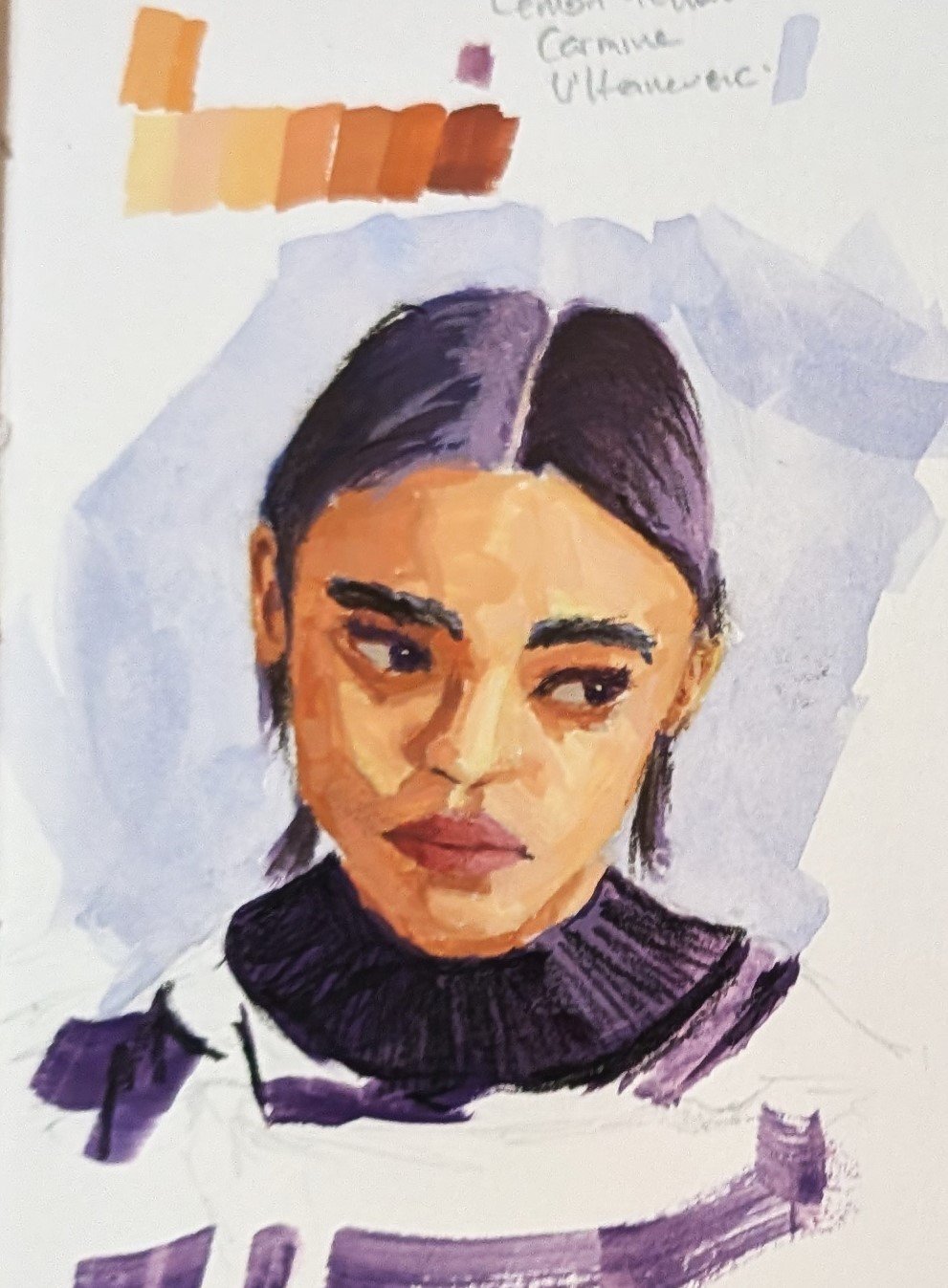
I started this portrait using a three-colour palette: Lemon Yellow, Carmine and Ultramarine. I restricted myself from using black for the initial piece and used an undertone purple for the darkest areas. I chose this palette as the reference image had an olive complexion and I wanted to test my ability to interpret and mix colours from primaries. The resulting mix wound up more orange than representative of the image, as I got caught in the thought process of "warm light, cool shadow", which actually led to me mixing bold oranges rather than subdued olives. However, sticking closely to value rules, I felt that overall the piece came together, and the strong oranges actually represented skin tones well on the finished piece. As I mentioned, sticking with the purples for the darks, I didn't feel that it captured the value of the muse's hair or jumper well enough, so I used a black Caran d'Ache pastel pencil to push those values more closely to the reference image. I used pastel pencil rather than oil as they render in a matte finish, which is a great complement to the gouache finish. I've tried to use oil pencil before but always got annoyed at the sheen created in the applied areas versus the gouache's matte finish.
Working through this piece I started focusing on shapes and larger brush strokes, which I must say was beginning to make me feel like the results were getting closer to what I was looking for. Doing it this way I could feel my brain making its own interpretations of light and shadow shapes as I was taking the brush to the page. A big step forward for my observational skills. The pieces are still not the cleanest, but I feel them moving in the right direction. My big takeaways from the first head were shape and value, which reduced my fear about colour choices to some extent, allowing me to be more relaxed during the painting.
Complexion two
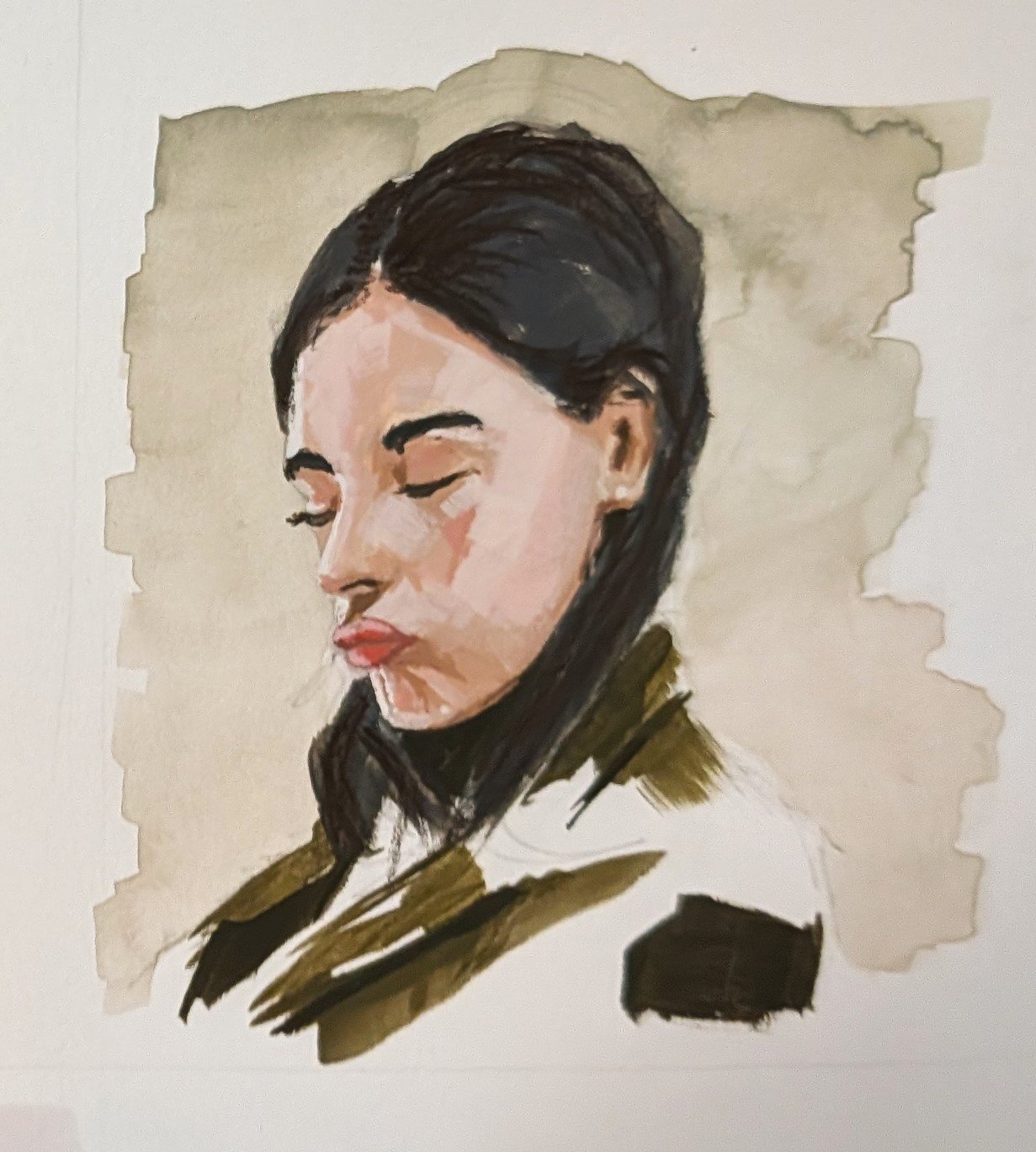
I went with the Zorn palette for this piece, Yellow Ochre, Flame Red, Ivory Black and white, as the muse had a pale complexion under neutral light. I also chose this reference for two additional reasons that would challenge myself: head angle, and a subtle expression of the face (pouting lips). What I couldn't nail in the underdrawing I found I was able to somewhat sculpt using the paints.
This piece gave me a number of issues during the initial laydown, where my colours and values felt completely off on a number of occasions. I traced the root of this back to the reference not having strong and clear form in the shadows. The lighting in this image was more subtle around the shapes, with only a couple of small, very dark areas to define form. This really pushed me to step back a number of times during the process and problem-solve, firstly the mixes and then the approach. With gouache, I was able to walk away, let the palette dry out, have a think and then return with no issues of my original mixes being lost. This was really helpful for me to observe, as it reduced all the time constraints I was putting on myself, which helped me relax into the problem solving. I'm still working on my value steps, though I found with this image that subtleties played a key part, and to achieve those subtleties in value I just played between mixes of the values I had already created on my palette. For example, if I wanted to move between value 3 and 4 but only had those two, I would just mix the two together off at the side to create more discrete value steps. You also have the opportunity with these side mixes to alter the colour slightly and play a bit with the hue, which I think I'll be keeping in mind for the future, when I'm brave enough to venture into the wilder territory of free-colour portraits, similar to my last post. Really happy again with the overall result of this piece, however, and it locked me in to test the Zorn out on the last two complexions to really push it and see what it, and I, were capable of.
Complexions three and four
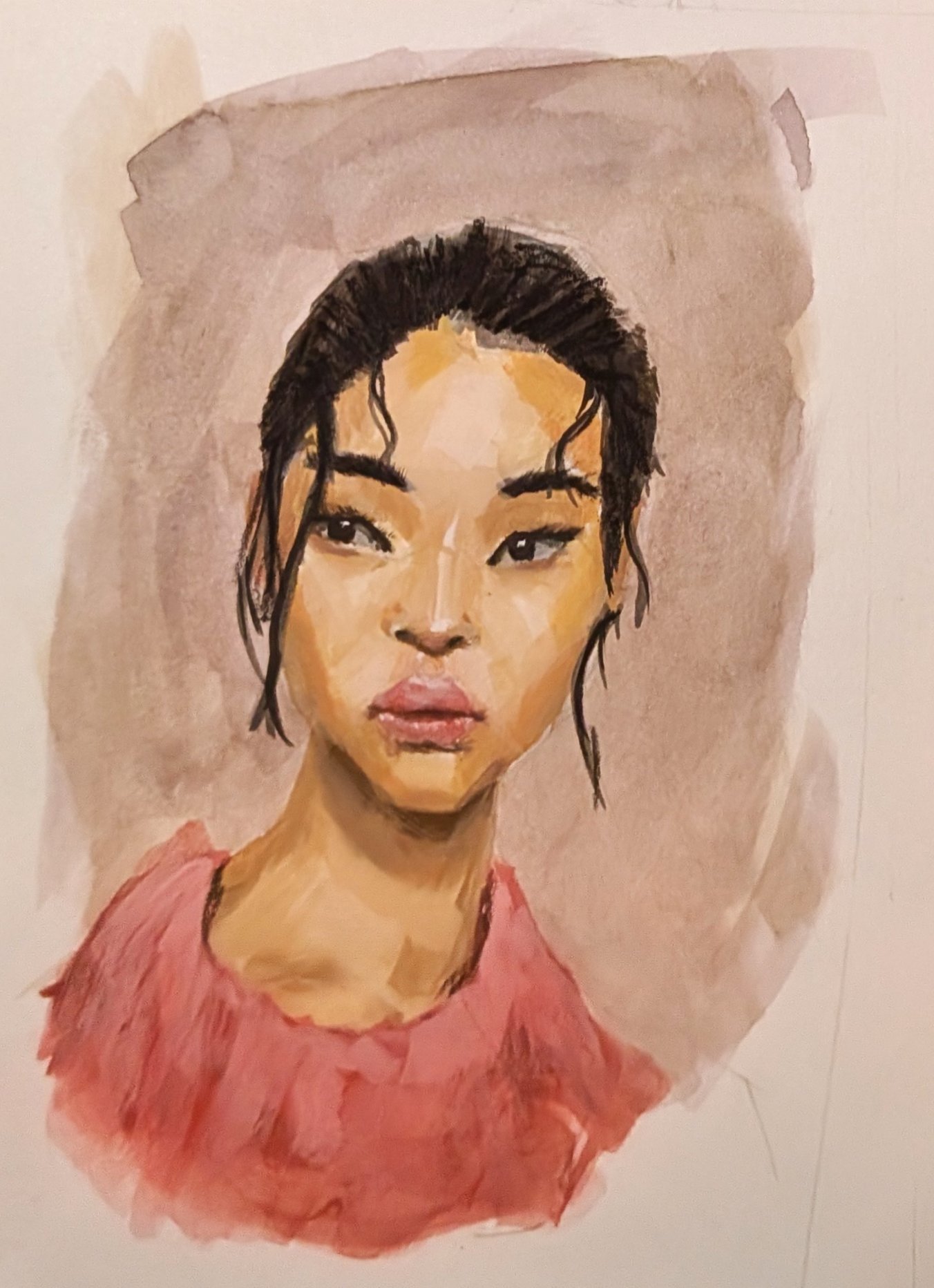
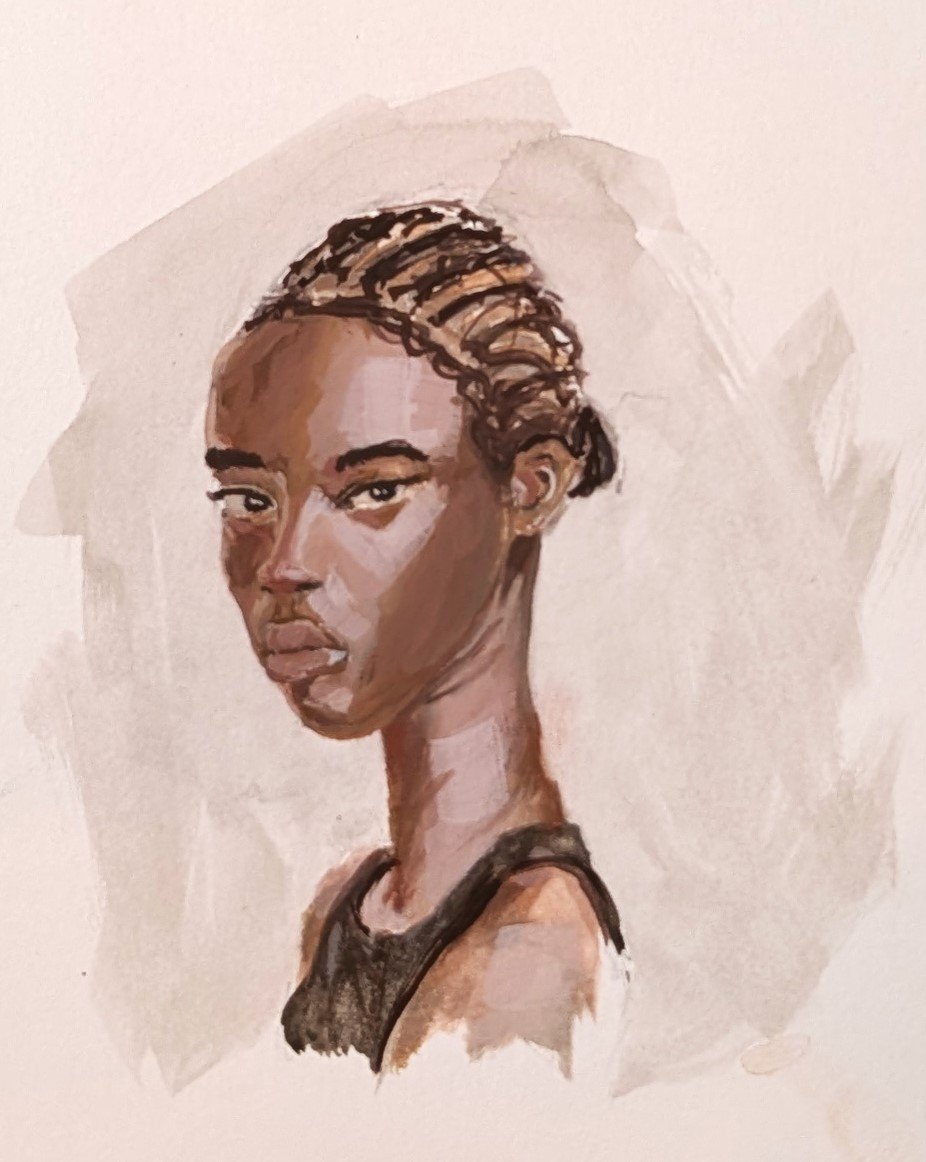
Complexions three and four were very new attempts for me, and although very different, the process, mishaps and correction stages wound up much the same. I miscalculated the initial mixes, laid down a fair amount of paint and then realised I wasn't happy with either the hue or the value. In both instances this caused me to create a remix on the palette and then reapply the paint layers. With gouache, if you get the consistency right, it is a dream to layer because of its opaque nature, and in some cases, if the mix is more on the transparent side, you get a happy accident that blends with the underlayers. Anyway, my main focus for these, outside of hue, was using the largest brush I was comfortable with for as long as possible to lay down the shapes, then working smaller only when it was close to impossible for me to do otherwise. Slowly I started seeing the value in this process in terms of the loose feeling I'm aiming for in my paintings. With the darker complexion hues I lost, to an extent, my original underdrawing, but persevered and continued on until I got a result I was happy with, hard stopping and remembering: it's just a study. A study in which I learned an incredible amount. Although not the best heads, I feel they are a great improvement for me towards reaching my goal, which is paints over pencil. As much as I love the pencils, and the opportunity is there to be loose, the result with paint appeals more to my taste at the moment and to what I'm looking to achieve.
Where the tools sat
The first head went through Palette Extractor with the value scale and the new temperature band before I mixed anything, and for the three Zorn heads I used Shape Simplifier for the shapes and Paint Mixing for extraction. I used some of the new temperature features, but still found it was more that I'd be correcting mistakes and hues while I painted. I think I've discovered the most important thing is: mix your best guess, then get paint on paper as soon as possible.
The palette
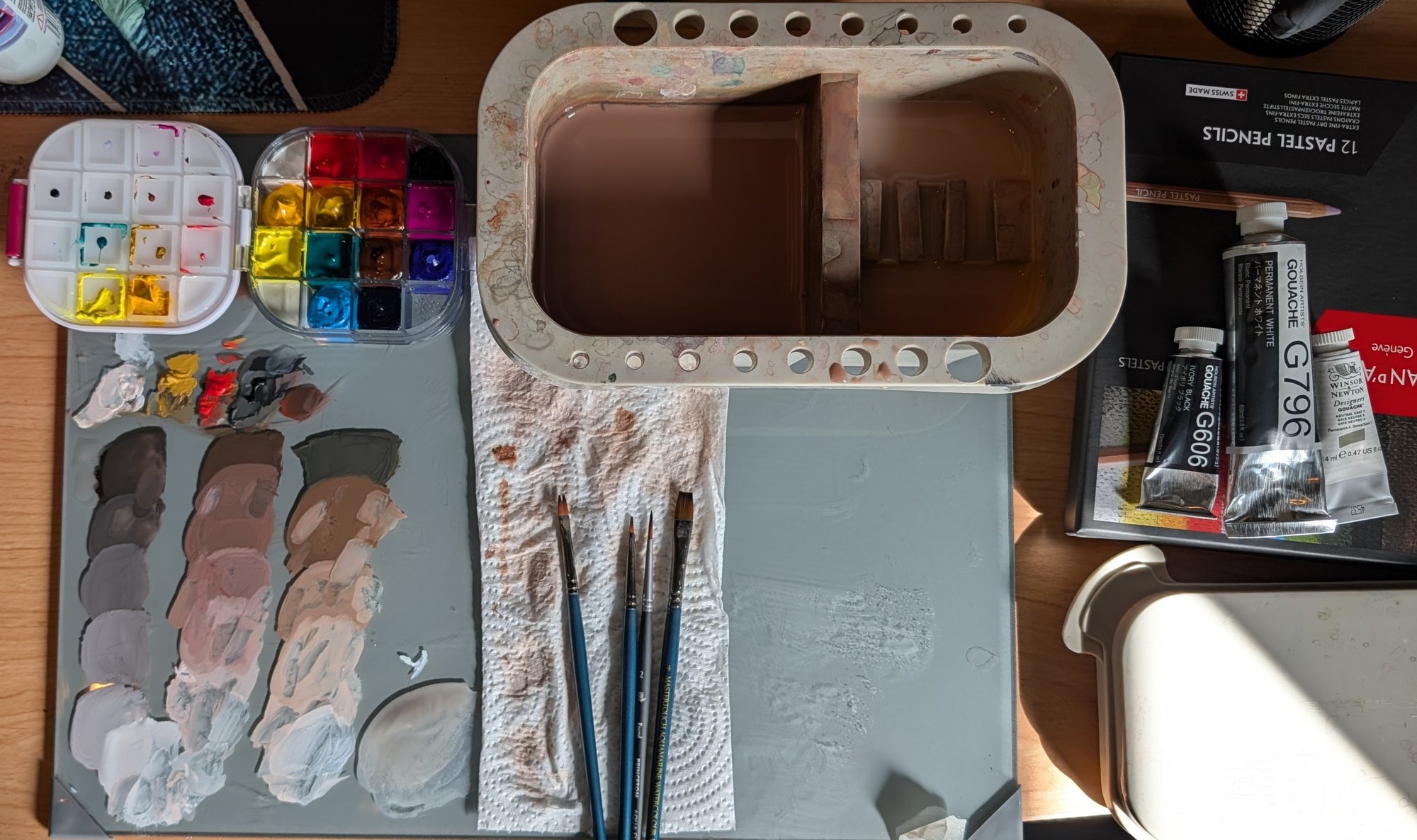
I introduced a new tool to my arsenal for this work, called a Transon airtight paint palette. It holds my gouache perfectly, and I found that it led to far less excess paint being left on my palette to dry after the session, as I could scoop what I needed when I needed it, versus squeezing piles out from tubes unsure of how much I might require for the painting. You can see it in the top left of the palette image I took following the last complexion study.
Next
I'm sticking with Zorn for now, as I'd like to get familiar with it before adding anything to it. If a picture needs a green I'll bring in a blue, and I'll choose it before I start instead of partway through. Expressions and hands are the next posts. My biggest focus is to be more confident and bold with the brush, once I have a better degree of understanding of my mixes and palette control.
Materials used
- Holbein Artists' Gouache: Lemon Yellow, Carmine, Ultramarine (head 1); Yellow Ochre, Flame Red, Ivory Black, white (heads 2-4)
- Caran d'Ache pastel pencil, black
- Transon airtight paint palette
- Graphite pencil
- Stillman & Birn Zeta sketchbook
- MasterTouch Aquamarine watercolour flat, size 4
- Princeton Aqua Elite round, size 8